
Sepsis (secretion) is an acute systemic infection caused by various pathogens invading the bloodstream, multiplying in the blood, and producing toxins. The factors that cause sepsis are as follows:
Sepsis is a serious disease. Statistics show that approximately 5 million new cases of sepsis are diagnosed in my country each year, with up to 1 million deaths, making it a leading cause of death among non-cardiac patients in intensive care units.
The systemic inflammation caused by sepsis can lead to acute brain dysfunction, manifesting as delirium, coma, and cognitive impairment. Nearly half of sepsis patients develop brain sequelae. While the survival rate of sepsis patients is increasing with advancements in medical technology, improving cognitive impairment among sepsis survivors remains a key research topic in the medical field.
Based on the fact that systemic inflammation is a key characteristic of sepsis, and that hydrogen molecules from Hydrogen Inhalation Machine have anti-inflammatory and antioxidant mechanisms, a research team at the University of São Paulo, Brazil's top university, has twice attempted to use hydrogen inhalation to improve cognitive impairment in sepsis patients.
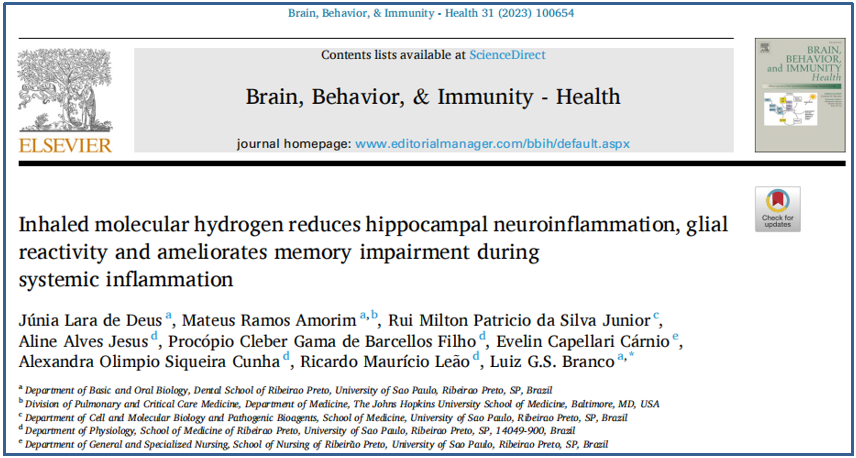
In 2023, the University of São Paulo in Brazil published a groundbreaking paper describing the mechanism by which inhaled hydrogen molecules from Hydrogen Inhalation Therapy Machine improve hippocampal neuroinflammation, glial reactivity, and systemic inflammation. This article was published in the internationally renowned journal *Elsevier*.
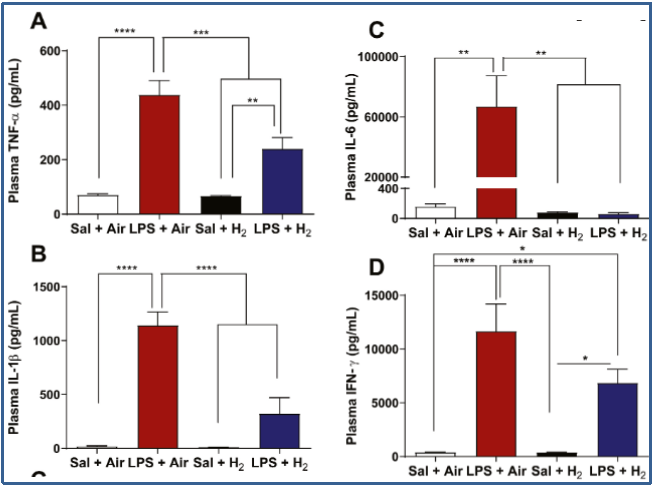
Scientists used lipopolysaccharide (LPS) to induce systemic inflammation (SI) to simulate sepsis, simultaneously triggering neurological inflammation in different areas related to memory and learning. In this experiment, to study the effects of hydrogen, oxygen, and air on sepsis (LPS), four groups were set up:
Sal+Air: Saline injection + air inhalation
LPS+Air: LPS injection + air inhalation (sepsis group)
Sal+H2: Saline injection + hydrogen/oxygen inhalation
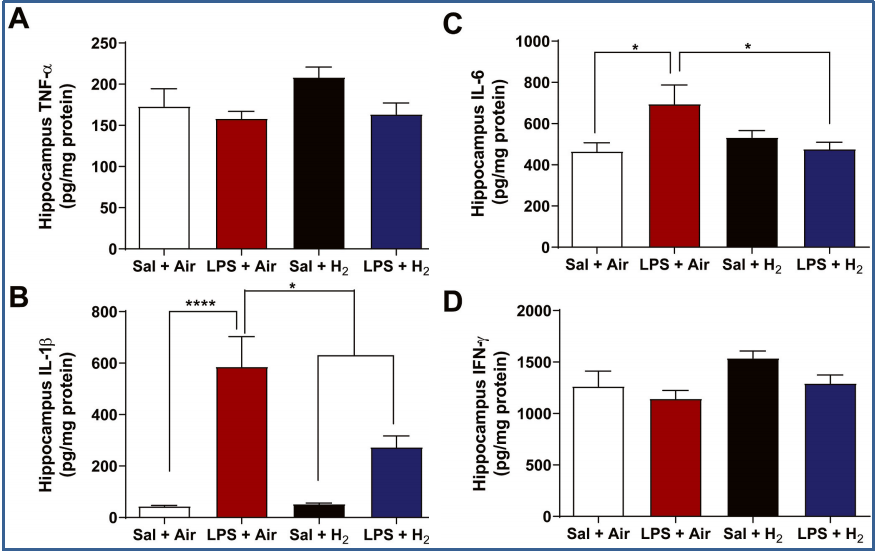
LPS+H2: LPS injection + hydrogen/oxygen inhalation (sepsis group) Scientists first tested the levels of four types of pro-inflammatory factors in the plasma of each group. The results showed that in the saline injection sham surgery group, pro-inflammatory factors remained stable; in the LPS injection sepsis group, pro-inflammatory factor levels increased—the red bars (air inhalation) in the graph below indicate a surge in various pro-inflammatory factors; and the hydrogen/oxygen inhalation group showed significantly lower levels of pro-inflammatory factors. This comparison demonstrates the inhibitory effect of hydrogen/oxygen inhalation on plasma pro-inflammatory factors.
To observe neuroinflammation in a LPS-induced sepsis model, scientists stained sections of the CA1 cell in the dorsal hippocampus. The results showed that hydrogen-oxygen inhalation significantly reduced the intensity of LPS induction, with lower reactivity in microglia and astrocytes.
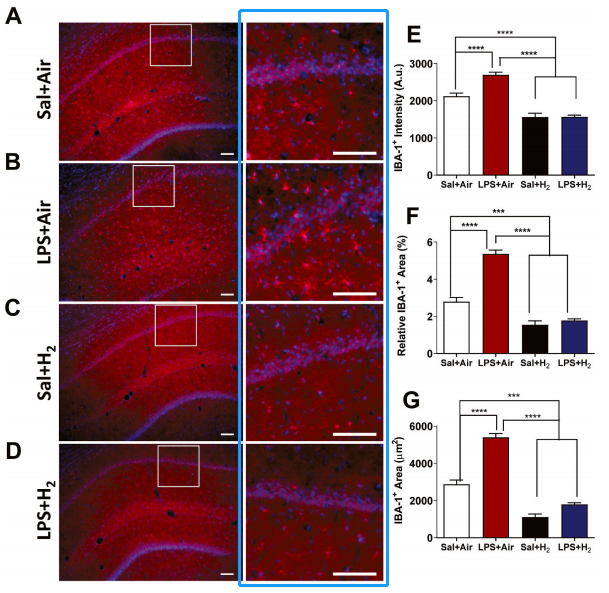
The image above shows two rows of microscopic photographs of microglia (IBA-1+), with the right side showing a magnified view. It can be seen that the absorption of hydrogen and oxygen inhibited changes in the intensity and area of microglia (IBA-1+), maintaining a level similar to the normal group (sham-operated group), while the sepsis air group (red bars) showed very significant changes.
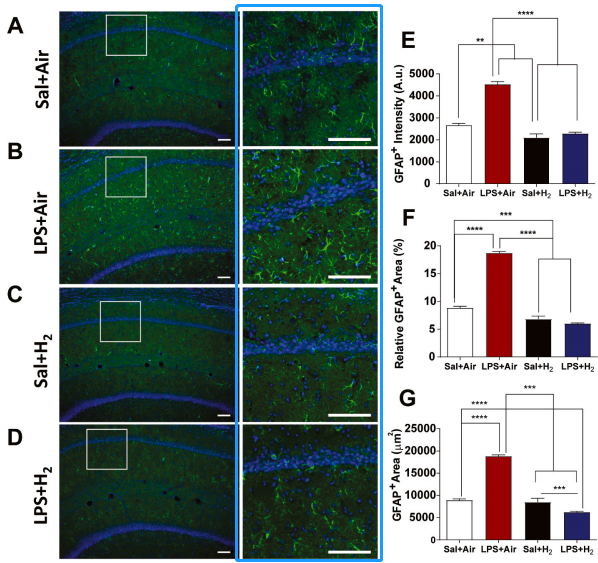
Similarly, microscopic images of GFAP in astrocytes also show that hydrogen and oxygen inhalation reduces the intensity and area of astrocytes in the LPS-induced sepsis model.
Microglia are smaller, oval-shaped cells than astrocytes. They primarily secrete neurotransmitters in the brain, regulating and controlling neural activity, and participating in processes such as memory, thinking, and learning.
Astrocytes are larger, star-shaped cells whose main function is to control and regulate neural activity in the brain, and participate in processes such as memory, cognition, and logical thinking.
Similarly, scientists also tested the levels of pro-inflammatory factors in plasma, and the results showed that hydrogen-oxygen inhalation inhibited the pro-inflammatory factors of sepsis, as follows:
In this experiment, scientists compared the long-term memory, short-term memory, and stress response of different groups. The results showed that hydrogen-oxygen inhalation had a beneficial effect on cognitive impairment caused by sepsis. (See below:)
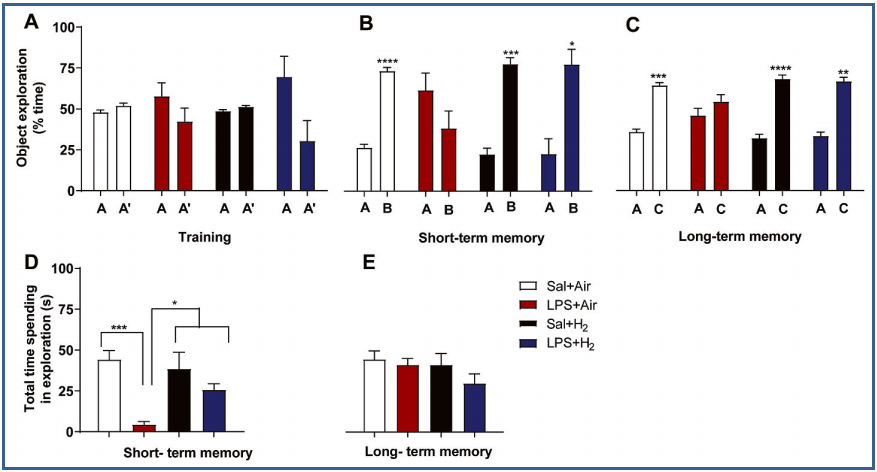
Hydrogen-oxygen inhalation reduces the activation of microglia and astrocytes, which are related to cognition, and inhibits the surge of pro-inflammatory factors, thereby suppressing the neuroinflammatory response caused by sepsis and alleviating cognitive impairment and memory loss. No toxic side effects have been reported in over a decade of clinical trials involving hydrogen-oxygen inhalation. Brazilian scientists also stated in their original research that "this is a relatively easy-to-use, inexpensive, and effective method."
With advancements in medical technology and increased life expectancy, many elderly patients with serious diseases (cancer, stroke, etc.) experience sepsis and postoperative delirium after surgery. In addition to the aforementioned Brazilian team's animal model of sepsis-induced cognitive impairment, Professor Xie Keliang's team at Tianjin Medical University in China has used high-concentration hydrogen-oxygen inhalation in human clinical trials to improve postoperative delirium. They found that pre-treatment with hydrogen-oxygen exerts anti-inflammatory and antioxidant effects, which can prevent and improve postoperative delirium in elderly patients.
Given the high cost of sepsis treatment and the economic burden of long-term sequelae, hydrogen-oxygen inhalation may be a potential method for preventing sepsis-related cognitive impairment and improving neurodegenerative diseases in humans!
If you have any questions about your Best Hydrogen Inhalation Machine, please feel free to contact us. We are committed to becoming the world's leading provider of hydrogen technology products.
committed to becoming the world'eading provider of hydrogen technology products
Tel : 13538439078
Whatsapp & Wechat : 13538439078
Whatsapp & Wechat : 13424783848
Skype : cindyzourui
Room 807, Building 4, No. 2 R&D 5th Road, Songshan Lake,Dongguan City,Guangdong Province,China